
Jefferson County Court Records After Arrest
Court records after a Jefferson County jail arrest begin after law enforcement books the person and the criminal case moves toward the court. Booking happens at Jefferson County Jail under the Sheriff's Office. The court side starts when a complaint, information, indictment, hearing entry, bond order, or other filing is entered into the Idaho trial court system. That court record is the better source for formal charges, charge changes, case status, hearing dates, and final outcomes.
The jail record and the court record answer different questions. Custody lookup asks whether the person is still held, released, transferred, or listed for notification through VINE. The court record asks what the prosecutor filed and what the judge ordered. Use Jefferson County jail inmate records for custody and booking routes. Use Jefferson County jail mugshots for booking-photo request limits. Court records after an arrest should not be read as proof of guilt, because a charge is only an allegation until conviction or judgment.
The official court path is local but statewide in format. Jefferson County cases are part of Idaho's iCourt public portal, while older files, certified copies, or records not visible online may require the Jefferson County Clerk or courthouse. The Prosecuting Attorney, Paul Butikofer, is the local official who reviews law-enforcement referrals and signs or files charges when prosecution goes forward.
Jefferson County Court Record Search
Start with the Idaho iCourt Portal. Public users can use Smart Search for case lookup and Search Hearings for calendar lookup. The iCourt public materials say Idaho's current court-record system covers all counties, includes public trial court case status, and generally has electronic court records from 1995 forward. The portal attempts hourly working-day updates as trial court staff enter changes, so a very new arrest may not show until the charge or hearing is filed.
The iCourt Smart Search page lets a user search by record number or party name, then filter by county, case type, status, file dates, and other criteria. For upcoming appearances, the iCourt Search Hearings page can be set to Jefferson County and Jefferson - Criminal. If a search returns no result, it may mean the case has not been filed, the name format is wrong, the matter is sealed or exempt, or the record is older or not exposed in the public portal.
The official iCourt Portal home captured in this image shows the public search starting point for Idaho court records after arrest.
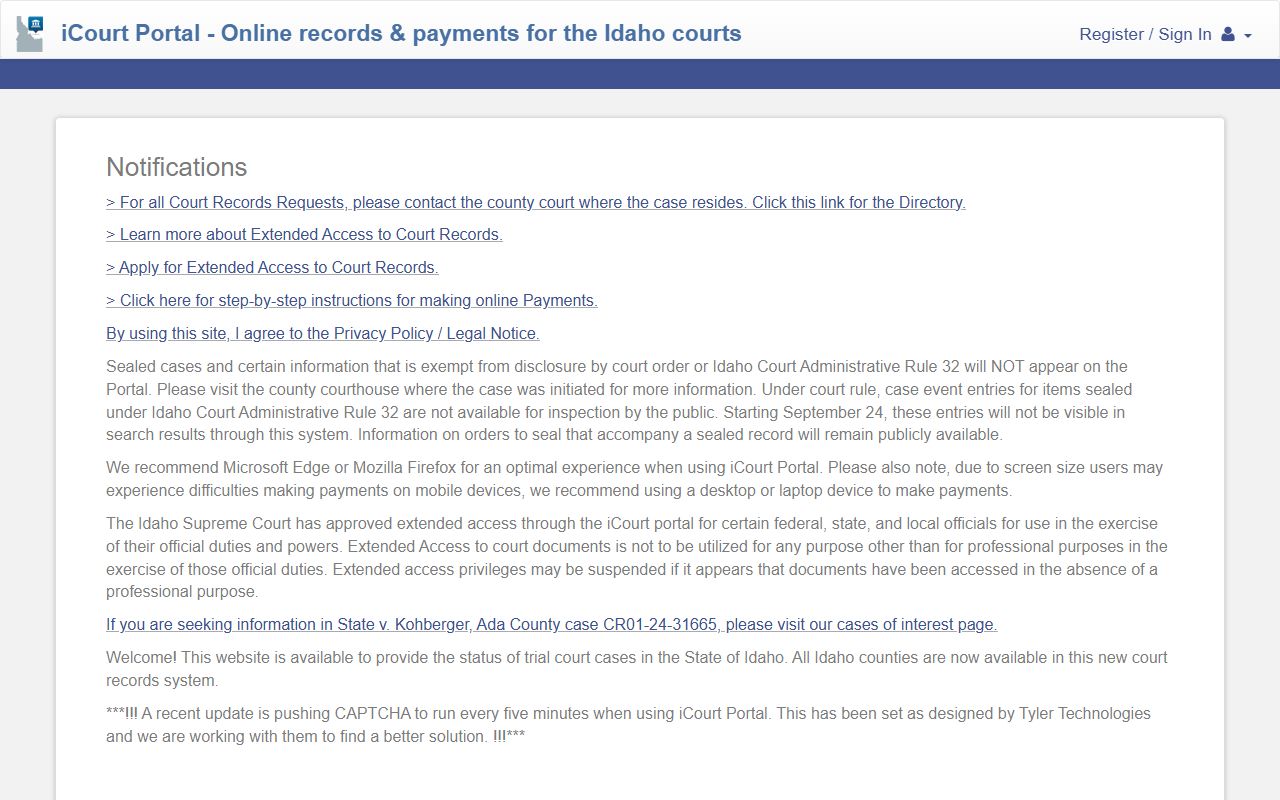
Use the portal for filed court information, then use the Jefferson County court clerk when a certified copy or older file is needed.
| iCourt Field | Type | Use for Jefferson County |
|---|---|---|
| Record number or name | Text | Search by case number or Last, First Middle Suffix format. |
| Filter by Location | Dropdown | Select Jefferson County instead of all Idaho counties. |
| Include Cases | Checkbox | Keep cases included for criminal court records. |
| Case Status | Filter | Narrows open, pending, closed, or disposed cases when available. |
| File Date Start and End | Date filters | Useful when the arrest date is known but the case number is not. |
| Booking Number | Advanced filter | Can help when the booking number is known from jail records. |
Arrest to Jefferson County Court Records
The arrest-to-court pathway is a sequence, not one database entry. A person is arrested, transported, searched, booked, photographed, fingerprinted, screened, and assigned initial housing. Idaho Criminal Rule 5 then requires an arrested defendant to be brought before a magistrate without unreasonable delay and not more than 24 hours after arrest, excluding Saturdays, Sundays, and holidays. At that first appearance, the court covers the charges, bail rights, counsel rights, communication rights, and preliminary-hearing rights where they apply.
After that point, the charging record depends on the prosecutor and the court. The Jefferson County Prosecuting Attorney prosecutes criminal actions in District Court and the Magistrate Division when the State or County is a party. The county page identifies Paul Butikofer as Prosecuting Attorney. Idaho Criminal Rule 3 allows a criminal proceeding to begin by complaint or indictment. Idaho Criminal Rule 7 requires felony prosecution by indictment or information, and an information must be signed by the prosecuting attorney.
- Confirm the person was booked or held through jail, VINE, or sheriff contact if custody status matters.
- Search iCourt Smart Search by name or case number and filter to Jefferson County.
- Use Search Hearings with Jefferson - Criminal to check public hearing dates.
- Compare booking labels with filed counts, because prosecutor review can change the charges.
- Call the clerk or court for certified copies, older files, or records not visible online.
The local prosecutor page is a useful source for office identity and duty. The screenshot comes from the Jefferson County Prosecuting Attorney page.
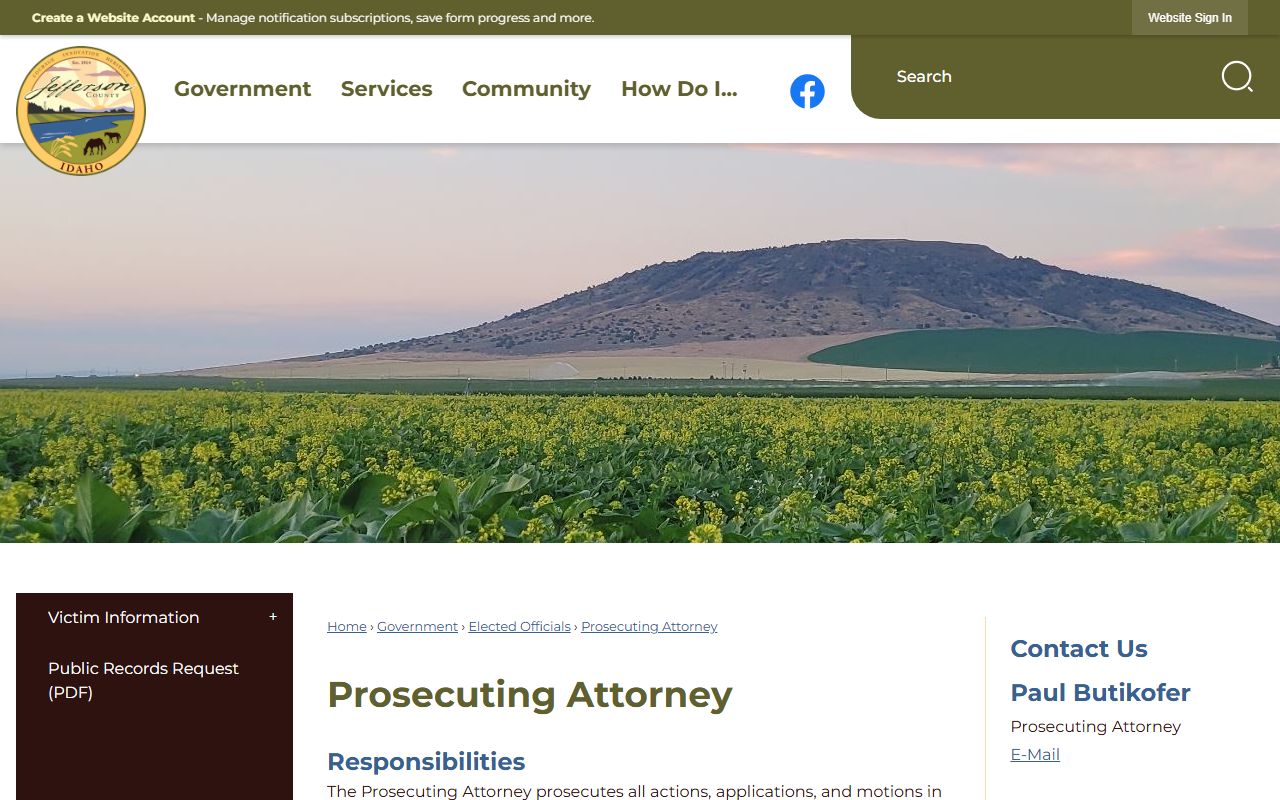
The prosecutor's role explains why a jail booking charge can differ from the court charge that later appears in iCourt.
Jefferson County Arrest Charging Records
Charging documents are the bridge between a jail arrest and the court record. They state what the government alleges, identify the legal basis for each count, and set the case on a court track. A complaint may start the case quickly after arrest. In felony matters, a preliminary hearing, waiver, grand jury, or other rule-based step can lead to an information or indictment. Arraignment follows once the indictment or information is in place.
| Document | What It Does | Jefferson County Use |
|---|---|---|
| Complaint | Begins a criminal proceeding by written accusation. | Often appears early after arrest and first appearance. |
| Information | Formal felony charging document signed by the prosecutor. | Used after the rule-based felony path allows filing. |
| Indictment | Formal charge issued through a grand jury process. | Can replace a preliminary-hearing path in felony cases. |
Read the filed document, not only the docket title. Rule 7 requires an indictment or information to state the statute, rule, regulation, or other provision for each count. That citation can clarify whether a charge is a misdemeanor, felony, enhancement, amended count, or dismissed count.
Jefferson County Charge Status
Charge status changes as the case moves. A charge may be pending after filing, amended after review, reduced through plea talks, dismissed by court order, or resolved by judgment. A booking label can also be broader than the filed charge. For example, a jail record may start with an arrest label while the prosecutor later files fewer, different, or more precise counts.
| Status | Meaning in a Court Record | Search Note |
|---|---|---|
| Pending | The charge remains active and has not reached final disposition. | Check hearing dates and bond orders. |
| Amended | The filed charge text, count, level, or citation changed. | Review later docket entries, not just the first complaint. |
| Reduced | The case moved to a lower or different offense level. | Often appears near plea or disposition entries. |
| Dismissed | The court removed the charge from the active case. | A dismissal is not the same as expungement. |
| Disposed | The count or case reached a final outcome. | Look for judgment, sentence, or dismissal details. |
Jefferson County Bond After Arrest
Bond and release information belongs to the court record once a judge sets conditions, but jail staff still confirm whether a person can leave custody. Idaho Criminal Rule 5 requires the magistrate at initial appearance to advise an arrested defendant of the right to bail, the right to counsel, and related rights. Official Jefferson County jail pages did not publish a local bond schedule, accepted payment methods, or bond counter hours, so case-specific bond questions should be checked with the court, clerk, and jail.
| Release Type | Meaning | Where to Confirm |
|---|---|---|
| Cash bond | Money paid as security for appearance and compliance. | Court or clerk for amount and payment routing. |
| Surety bond | A bail agent or surety posts bond under contract. | Court order first, then jail custody status. |
| Personal recognizance | Release based on a promise to appear and obey conditions. | iCourt, court, or clerk record. |
| No-bond hold | Release is not allowed at that point in the case. | Court order and jail confirmation. |
| Detainer or hold | Another agency or case may block release. | Jail and the agency that placed the hold. |
A resolved bond entry does not always mean immediate release. Jefferson County release processing includes identity verification, authority for release, and a check for pending detainers, holds, or warrants. If another court, probation, parole, federal, or immigration hold exists, the person may remain in custody after the local bond issue is addressed.
Jefferson County Court Contacts
The Jefferson County courthouse and clerk are the official local contacts when iCourt is not enough. The Idaho Supreme Court courthouse directory lists the court at 210 Courthouse Way, Suite 120, Rigby, ID 83442, with phone 208-745-7736. The Jefferson County Clerk page identifies the Clerk as Clerk of the Courts and lists the Clerk's Office at 210 Courthouse Way, Suite 100, phone 208-745-7756, with weekday public hours.
Jefferson County Court
210 Courthouse Way, Suite 120
Rigby, ID 83442
208-745-7736
Jefferson County Clerk
210 Courthouse Way, Suite 100
Rigby, ID 83442
208-745-7756
Monday-Friday, 9 am to 5 pm
For jail booking records, incident records, or sheriff records, use the Sheriff's Office public-records process instead of the court clerk. The split matters because court records show filed case activity, while sheriff records show law-enforcement and booking material that may be restricted by investigation, privacy, safety, or open-case discovery rules.
Jefferson County Arrest Warrants
No official Jefferson County Sheriff public active-warrant database was located in the county materials. That makes iCourt, the court, the clerk, and the Sheriff's Office the official warrant-related channels. iCourt may show bench-warrant activity in an existing case, but it is not a complete live warrant system. The Sheriff's Office can route local law-enforcement questions, and the court can route case-specific bench-warrant, hearing, or court-order questions.
Idaho Court Administrative Rule 32 limits public access to unreturned search warrants and unreturned arrest warrants, except bench warrants. It also says arrest warrants or summonses may be disclosed by law-enforcement agencies at their discretion. A missing online record therefore does not prove no warrant exists. A person with warrant risk should use the issuing court, the Sheriff's Office, or counsel instead of unofficial warrant-payment or lookup sites.
| Channel | Use | Limit |
|---|---|---|
| iCourt Smart Search | Existing case and public docket events. | Not a full active-warrant list. |
| Search Hearings | Upcoming Jefferson - Criminal appearances. | Does not confirm every warrant. |
| Sheriff's Office | Local custody and law-enforcement routing. | Some warrant facts may be nonpublic. |
| Court or Clerk | Case-specific orders, bench warrants, and copies. | Sealed or exempt records may not be released. |
Charges, Convictions, Sealed Records
Charges, convictions, sealed records, and expunged records are not the same thing. A filed charge is an allegation. A conviction is a final adjudication, plea, or judgment. A sealed record may exist but be hidden from public view under a court order or rule. Expungement in Idaho is limited and tied to certain arrest, fingerprint, and criminal-history records when statutory conditions are met.
| Comparison | First Term | Second Term |
|---|---|---|
| Charge vs. conviction | A charge is an accusation filed or listed in a case. | A conviction follows a guilty plea, verdict, or judgment. |
| Booking label vs. filed charge | A booking label starts in jail or law-enforcement records. | A filed charge is the prosecutor and court allegation. |
| Sealed vs. expunged | Sealed records are hidden from ordinary public access. | Expunged arrest or fingerprint records follow a limited statutory process. |
Idaho Code 67-3004 supports expungement of certain arrest and fingerprint records when no charge is filed within the stated period, when the person is acquitted of all offenses, or when all charges are dismissed, with a written request and supporting records. It should not be stretched into a promise that every court entry, jail record, or booking photo disappears.
Idaho Criminal History Records
The Idaho State Police Bureau of Criminal Identification is separate from iCourt and Jefferson County Jail. BCI maintains Idaho's central criminal-history repository, based on fingerprint arrest records reported by Idaho criminal justice agencies. It can be searched by name or fingerprints and covers Idaho arrests, not out-of-state records, FBI records, or every federal conviction.
BCI is the better route when a formal statewide criminal-history check is needed. The research listed current ISP fee notes of $25 for a fingerprint-based check and $20 for a name-based check. Local agencies may only check their own records for many non-criminal-justice uses, while BCI is the statewide source. Court records after a Jefferson County arrest still belong in iCourt or at the clerk; BCI is a separate background-record channel.
Important: Court, jail, and criminal-history records can be incomplete or restricted. Verify case-specific use with the originating agency.